Best AI for Code Review 2026: Claude, Gemini & GPT Benchmarks + Real PR Results
Claude Opus 4.7 leads multi-file logic. GPT-5.4 leads terminal tasks. Gemini 3.1 Pro leads full-repo context. Which one actually catches the bugs that cost you production incidents — and why the leaderboard won't tell you.
Tired of slow code reviews? AI catches issues in seconds. You decide what gets published.
Best AI for Code Review 2026: Claude, Gemini & GPT Benchmarks + Real PR Results
TL;DR: Each model leads a different benchmark and misses bugs the others catch. Claude Opus 5 (GA July 24) topped independent SWE-bench evaluations at 96% as of September 2026 and is selectable inside Git AutoReview alongside Claude Fable 5 (95.0%) and Opus 4.8 (88.6%, the longer-established workhorse). Opus 4.7 dominates multi-file logic, GPT-5.3 Codex leads terminal tasks, and Gemini 3.1 Pro handles full-repo analysis at the lowest frontier price. The model at position 1 on the leaderboard leaves a third of code review bugs untouched. Full scores, pricing, and what actually changes your catch rate below.
Updated September 1, 2026 with Claude Opus 5's independent SWE-bench standings (BenchLM's Aug 28 refresh and vals.ai) — Anthropic's own launch material for Opus 5 does not publish a SWE-bench Verified score.
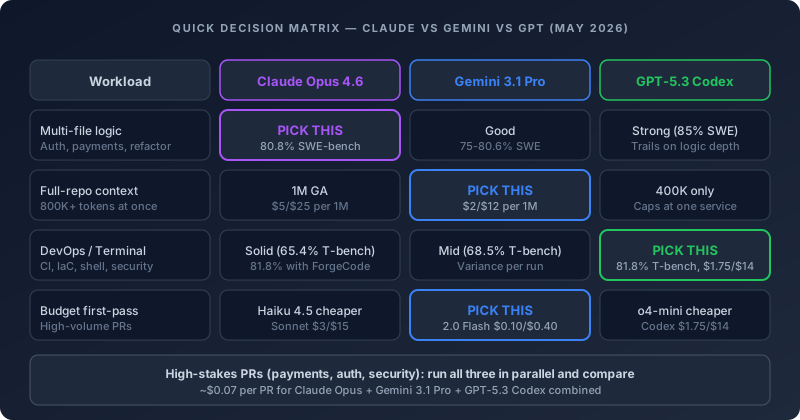
Quick answers for 2026
Which AI model has the best SWE-bench score?
Claude Opus 5 — GA since July 24, 2026 — now leads SWE-bench Verified on independent evaluations at 96% (BenchLM's Aug 28 refresh) to 97% (vals.ai); Anthropic's own launch material for Opus 5 skips a SWE-bench number and reports Frontier-Bench and CursorBench scores instead. Behind it: the invite-only Claude Mythos 5 at 95.5%, Claude Fable 5 at 95.0%, Claude Opus 4.8 at 88.6%, Opus 4.7 at 87.6%, GPT-5.3 Codex at 85%, Claude Opus 4.6 at 80.8%, and Claude Sonnet 4.6 at 79.6%. Gemini 3.1 Pro sat at 75% on the March snapshot; Google self-reported 80.6% but third-party testing placed the standardized score lower. The benchmark is considered contaminated for frontier models, so treat headline numbers with skepticism.
What is the best LLM for coding in 2026?
It depends on which job you need done. Claude Opus 5 topped independent SWE-bench Verified evaluations as of September 2026 (96%, BenchLM) and, as of September 2026, sits in Git AutoReview's model picker alongside Claude Fable 5 (95.0%) — Claude Opus 4.8 (88.6%) remains the longer-established workhorse, and Opus 4.6 wins multi-file logic reasoning at 80.8%. GPT-5.3 Codex wins Terminal-Bench 2.0 (81.8% with ForgeCode agent) for security, DevOps, and infrastructure work. Gemini 3.1 Pro wins competitive coding with LiveCodeBench Pro Elo 2,887 and handles full-repo analysis with 1M tokens of context at $2/$12 per million tokens — our Gemini 3.1 Pro code review deep-dive covers exactly where the 1M context wins over Claude and GPT on real monorepo PRs.
Which model is cheapest for code review?
Gemini 3.1 Flash-Lite at $0.25/$1.50 per million tokens is about 20x cheaper than Claude Opus 4.6 for first-pass reviews. GPT-5.3 Codex at $1.75/$14 is the cheapest frontier-tier model. The full per-token side-by-side lives on the AI API pricing tool — paste in monthly review volume and the calculator backs out the actual API spend per model. To run all three without tool juggling, Git AutoReview drives Claude, Gemini, and GPT from one $14.99 per month flat team plan with your own API keys (BYOK, typically $2–5/mo paid directly to the provider) — the subscription stays flat no matter how many PRs you merge.
Can I use Claude and GPT together on the same pull request?
Yes, and that is the pattern producing the strongest results in 2026. Git AutoReview runs Claude Opus 4.6, GPT-5.3 Codex, and Gemini 3.1 Pro in parallel on the same PR. You see all three models' suggestions side-by-side, pick the best ones, and approve before anything posts. Teams running multi-model review catch roughly a third more issues than any single model alone.
What does LiveCodeBench measure differently than SWE-bench?
LiveCodeBench tests models on competitive programming problems published after their training cutoff, which makes it harder to game than SWE-bench. Gemini 3.1 Pro leads LiveCodeBench with Pro Elo 2,887 — roughly 200 points ahead of Claude Opus 4.6 and GPT-5.3 Codex. LiveCodeBench rewards algorithmic reasoning; SWE-bench Verified rewards real-world bug-fixing on GitHub issues. Looking at both benchmarks together gives a more honest picture than either alone.
Which AI model hallucinates the least on code?
No single frontier model is meaningfully better than the others across all bug classes. Every model ships a meaningful rate of false positives — confident comments about bugs that are not bugs, fixes that break things, or concerns already handled elsewhere in the diff. The rate varies by code type: security and infrastructure code sees more false positives than pure business logic. The only reliable mitigation is human approval before AI comments publish to the PR, which is exactly why Git AutoReview defaults to that flow instead of auto-posting.
Picking between Claude, Gemini, and GPT for coding used to be straightforward — you checked the benchmarks, picked the highest number, and moved on. That stopped working around early 2026 when the models started specializing. One model now dominates SWE-bench Verified. A different one leads LiveCodeBench competitive coding. A third one wins Terminal-Bench for DevOps tasks. And the SWE-bench leaderboard itself is considered contaminated for many frontier models, which means the headline number you see on Twitter might not reflect what the model actually does on your code. The tooling decision matters as much as the model — our AI PR review guide walks through how multi-model review actually works in practice, including which combinations catch the most bugs.
We ran Claude Opus 4.6, GPT-5.3 Codex, and Gemini 3.1 Pro on hundreds of PRs and compared the results against the BenchLM leaderboard data. Claude catches logic bugs across files that the others miss entirely. GPT-5.3 Codex finds security flaws and infrastructure misconfigs that Claude overlooks. Gemini 3.1 Pro processes your entire monorepo in one shot with 1M tokens of context and leads on competitive coding benchmarks. Picking just one means missing roughly a third of the issues.
Which AI model is best for code review in 2026?
No single model catches everything — that is the honest answer after running all three on hundreds of PRs. Claude Opus 4.6 finds logic bugs that GPT misses entirely. GPT-5.3 Codex catches security flaws and terminal issues that Claude overlooks. Gemini 3.1 Pro processes your entire monorepo in one shot with its 1M token context window. The teams getting the best results run all three in parallel and compare.
Git AutoReview is the only AI code review tool with human-in-the-loop approval. It runs Claude, Gemini, and GPT in parallel on GitHub, GitLab, and Bitbucket. You compare results, pick the best suggestions, and approve before anything gets published. Unlike CodeRabbit and Qodo, nothing auto-publishes. Install free →
Claude Code vs Gemini CLI for PR Review: What the 2026 Tool Shift Actually Means
The dominant search intent for "claude vs gemini" shifted in 2026. Most developers now mean one of two terminal agents: Claude Code (Anthropic's agentic coding tool) or Gemini CLI (Google's command-line AI released May 2026). Neither is primarily a PR review tool — but both get compared to dedicated review tools because developers want to know which approach actually improves their merge queue.
Claude Code runs in your terminal, included in Claude Pro ($17/mo annual) or Claude Max ($100-200/mo for heavier usage). You describe a task in plain English and it reads files, writes code, runs tests, and iterates autonomously. For code review, it can analyze a diff and output findings directly in your terminal. The limitation: it works on your local checkout and does not integrate natively with GitHub pull requests, GitLab merge requests, or Bitbucket. Applying its findings to an actual PR requires manual work or a custom script.
Gemini CLI is Google's free command-line tool using the Gemini models. Like Claude Code, it processes code in a terminal context. The free tier covers most individual developer use cases. The same PR integration gap applies — terminal output does not become PR comments automatically.
Neither tool does what most teams actually need from a code review workflow: sitting on the pull request itself, running multiple models in parallel, showing you a side-by-side comparison, and requiring your explicit approval before a single comment goes live. That is the gap Git AutoReview fills — using the same Claude Opus 4.7 and Gemini 3.1 Pro models, but natively connected to GitHub, GitLab, and Bitbucket with a human-in-the-loop approval gate.
The decision is not "Claude Code vs Gemini CLI." It is "agentic coding tool vs PR review tool." Most teams that cut escaped bug rates use both: an agentic tool for writing code and a dedicated review tool for reviewing it before it merges. See the AI PR review guide for the workflow that combines both. For a full breakdown of pricing per review, platform coverage, and when each CLI tool actually wins, see the Claude Code vs Gemini CLI head-to-head comparison.
SWE-Bench Leaderboard 2026: Latest Verified Scores
SWE-bench Verified scores as of September 2026: Claude Opus 5 leads at 96% on BenchLM's September 1 refresh (vals.ai's harness puts it slightly higher at 97%) — Anthropic's own Opus 5 launch page doesn't publish a SWE-bench number, reporting Frontier-Bench and CursorBench scores instead. Behind Opus 5: Claude Mythos 5 at 95.5%, Claude Fable 5 at 95.0%, Claude Opus 4.8 at 88.6%, Opus 4.7 at 87.6%, GPT-5.3 Codex at 85%, GPT-5.4 at 84% (March snapshot), Claude Opus 4.6 at 80.8%, and Gemini 3.1 Pro at 75% (March snapshot). Anthropic shipped Claude Fable 5.1 and Mythos 5.1 on September 1 and published no SWE-bench Verified figure for either — that announcement reports Terminal-Bench 4.0, OSWorld 2.0, and CursorBench instead — so neither has entered the public leaderboard yet. The benchmark is considered contaminated for many frontier models — real-world testing on your codebase matters more than headline numbers.
| Model | Context | SWE-bench Verified | Terminal-Bench 2.0 | Input cost | Output cost | Best for |
|---|---|---|---|---|---|---|
| Claude Opus 5 | 1M | 96% | — | $5.00/1M | $25.00/1M | Current SWE-bench leader, selectable in Git AutoReview since Aug 2026 |
| Claude Fable 5 | — | 95.0% | — | $10.00/1M | $50.00/1M | Claude 5 flagship (GA Jun 9) |
| Claude Opus 4.8 | 1M | 88.6% | — | $5.00/1M | $25.00/1M | Longer-established Claude workhorse |
| Claude Opus 4.7 | 1M | 87.6% | — | $5.00/1M | $25.00/1M | Logic bugs, multi-file reasoning |
| GPT-5.3 Codex | 400K | 85% | 81.8% (ForgeCode) | $1.75/1M | $14.00/1M | Terminal, agentic coding, security |
| GPT-5.4 | 1M | 84%* | — | $2.50/1M | $15.00/1M | General-purpose, Computer Use API |
| Claude Opus 4.6 | 1M | 80.8% | 81.8% (ForgeCode) | $5.00/1M | $25.00/1M | Logic bugs, refactoring |
| Claude Sonnet 4.6 | 1M | 79.6% | — | $3.00/1M | $15.00/1M | Balanced cost/quality |
| Gemini 3.1 Pro | 1M | 75%* | 80.2% (TongAgents) | $2.00/1M | $12.00/1M | Full-repo analysis, competitive coding |
| Gemini 3.1 Flash-Lite | 1M | — | — | $0.25/1M | $1.50/1M | Budget, speed |
Claude Opus 5's SWE-bench Verified score is from BenchLM (September 1, 2026 refresh: 96%) and vals.ai (Aug 30, 2026: 97%) — Anthropic's own launch announcement doesn't report a SWE-bench Verified figure, using Frontier-Bench and CursorBench instead. Remaining scores are from BenchLM (June 9, 2026 refresh). The restricted-access Claude Mythos 5 (95.5%) is invite-only and absent from public harnesses, so we list Opus 5 as the practical leader with a public API. Entries marked * are from BenchLM's March 18 snapshot — the June table no longer lists GPT-5.4 or Gemini 3.1 Pro. Terminal-Bench 2.0 scores are agent+model combinations from tbench.ai — base model scores without specialized agents are significantly lower. ForgeCode is an agentic coding framework that wraps LLMs with tool-use scaffolding for terminal tasks. TongAgents is a multi-agent research framework from Tsinghua University. Company-reported numbers may differ from third-party evaluations.
One more number worth holding onto: the official swebench.com leaderboard — which runs every model through the same standardized bash-only mini-agent harness — tops out at 76.8% (Claude 4.5 Opus, February 2026 submissions), a full 12 points below the vendor-scaffold scores above. Neither view is wrong. Vendor and third-party numbers show what a tuned agent stack squeezes out of a model; the standardized harness shows what the bare model does when everyone gets identical tooling. The gap itself is the lesson: scaffolding is worth 5-12 points, which is more than the spread separating the top four models from each other.
Git AutoReview runs Claude, Gemini & GPT in parallel. Compare results side-by-side.
Install Free — 10 reviews/day → See Pricing
LiveCodeBench Leaderboard 2026: Claude vs GPT vs Gemini
LiveCodeBench tests models on competitive programming problems published after their training cutoff — making it harder to game than SWE-bench. The results paint a different picture from SWE-bench Verified, which is exactly why looking at multiple benchmarks matters.
| Model | LiveCodeBench Pro Elo | SWE-bench Verified | Terminal-Bench 2.0 |
|---|---|---|---|
| Gemini 3.1 Pro | 2,887 | 75% | 68.5% |
| Claude Opus 4.6 | ~2,700 | 80.8% | 65.4% |
| GPT-5.3 Codex | ~2,650 | 85% | 81.8% (ForgeCode) |
| Claude Sonnet 4.6 | ~2,600 | 79.6% | — |
Gemini 3.1 Pro leads LiveCodeBench with a Pro Elo of 2,887 — roughly 200 points ahead of Claude and GPT. Google's model handles algorithmic complexity and competitive coding problems better than either competitor, which translates into stronger performance on PR reviews that involve data structure choices and optimization tradeoffs. GPT-5.3 Codex dominates Terminal-Bench (shell scripting, CI/CD debugging), and Claude leads on multi-file logic reasoning. No single leaderboard tells the full story.
Latest AI coding model updates (June-August 2026)
The benchmark landscape shifts every few weeks. Here is what changed since March 2026:
- Claude Opus 5 — Anthropic's newest flagship, generally available July 24, 2026, at the same $5/$25 per million tokens as Opus 4.8. Now leads independent SWE-bench Verified evaluations at 96% (BenchLM's Aug 28 refresh) to 97% (vals.ai) — Anthropic's own launch page skips a SWE-bench number, reporting Frontier-Bench and CursorBench scores instead. Selectable in Git AutoReview's model picker since August 2026.
- Claude Fable 5 — Anthropic's Claude 5 family flagship, generally available June 9, 2026 at $10/$50 per million tokens. Scored 95.0% on SWE-bench Verified on both BenchLM and vals.ai's standardized harness at the time — since passed by Claude Opus 5. Selectable in Git AutoReview's model picker since August 2026 (v1.21.5), with your own Anthropic key (BYOK). A restricted-access sibling, Claude Mythos 5, scores 95.5%.
- Claude Opus 4.8 — $5/$25 per million tokens, 88.6% SWE-bench Verified. The longer-established workhorse in Git AutoReview's model picker, now alongside Claude Opus 5 at the same $5/$25 price.
- Claude Opus 4.7 — replaced Opus 4.6 as the Opus workhorse earlier this year. Higher benchmark scores across multi-file reasoning and extended thinking tasks. Pricing at $5/$25 per million tokens (same as 4.6). Teams currently on Opus 4.6 should evaluate the upgrade on their highest-stakes PRs first.
- Claude Opus 4.6 — Still available. 1M context window GA (March 13). Terminal-Bench 2.0 at 65.4%.
- GPT-5.4 — Released with ~1M context window and Computer Use API. SWE-bench Verified at 84%, just below GPT-5.3 Codex's 85%. Priced at $2.50/$15 per million tokens.
- Gemini 3.1 Pro — Google's latest frontier model with configurable reasoning modes (low/high effort). LiveCodeBench Pro Elo 2,887 is the highest competitive coding score of any model. Still in preview — no stable GA release yet.
- ForgeCode agent — An agentic coding framework that wraps LLMs with tool-use scaffolding for terminal tasks. Pushed GPT-5.3 Codex to 81.8% on Terminal-Bench 2.0, the highest agent+model combination score. Claude Opus 4.6 with ForgeCode also hits 81.8%. The framework handles tool selection, error recovery, and multi-step shell workflows automatically.
- TongAgents — A multi-agent research framework from Tsinghua University that pairs LLMs with specialized sub-agents for complex tasks. Gemini 3.1 Pro with TongAgents scored 80.2% on Terminal-Bench 2.0 — competitive with ForgeCode despite being a research project rather than a commercial product.
The biggest takeaway: GPT-5.3 Codex and Claude Opus 4.6 now tie on Terminal-Bench when paired with the same agent (ForgeCode), which means the model gap on DevOps tasks is closing. The agent framework matters almost as much as the underlying model — Gemini 3.1 Pro jumped from ~55% base to 80.2% with TongAgents. For code review, the practical difference comes down to what kind of bugs you care about most.
Is Claude Opus 4.7 the best AI for code review?
Claude Opus 4.7 sits below Opus 4.8 and the new Fable 5 in Anthropic's lineup now, but it remains a model teams standardize on for complex multi-file reasoning tasks. Opus 4.6's SWE-bench Verified results put it ahead of most models on logic-heavy reviews, and 4.7 improves on that baseline while keeping the same $5/$25 per million token pricing. The practical difference shows up in how it traces objects through middleware and database calls across files, catching logic bugs that simpler models miss because they don't follow the data flow far enough.
The biggest upgrade from Opus 4.5: the context window expanded from 200K to 1M tokens (generally available since March 13, 2026), and maximum output doubled to 128K tokens. On Terminal-Bench 2.0, Opus 4.6 scored 65.4% vs 59.8% for Opus 4.5. Anthropic's internal benchmarks showed ARC AGI 2 jumping from 37.6% to 68.8%, which suggests the reasoning improvements aren't just cosmetic.
Extended thinking mode
Claude Opus 4.6 supports extended thinking, a feature where the model generates internal reasoning before producing the final response. You control this with an effort parameter:
- Low effort: Fast responses for simple reviews
- Medium effort: Matches Sonnet 4.6 quality while using 76% fewer tokens
- High effort: Exceeds Sonnet 4.6 by 4.3 percentage points, uses 48% fewer tokens
The model preserves thinking blocks across multi-turn conversations. If you ask follow-up questions about a code review, Claude remembers its reasoning from previous turns.
What Claude does well
Where Claude shines is multi-file reasoning — give it a PR that touches your auth flow across six files (middleware, services, repository layer, controllers) and it connects permission checks in one service to session writes in another, flagging timing windows that only appear under concurrent load. Anthropic's SWE-bench testing repeatedly showed this pattern: Claude catches race conditions between session creation and permission assignment that simpler models treat as isolated, single-file concerns.
On Terminal-Bench 2.0, Claude Opus 4.6 scored 65.4%, up from 59.8% on Opus 4.5. Anthropic reported that for long-horizon coding tasks, the model achieves higher pass rates while using up to 65% fewer tokens — a meaningful cost reduction for teams running it at scale.
The explanations are what set Claude apart from the competition for many teams — junior devs actually learn from the reviews instead of just fixing what the AI tells them to fix. Claude breaks down the entire call chain, shows where the failure happens, and explains what the suggested fix actually changes, which turns every review into a teaching moment.
Claude Sonnet 4.6: close to Opus quality at 40% the cost
Sonnet 4.6 now has the same 1M token context (GA) as Opus with 64K max output tokens — at $3/$15 per million tokens instead of $5/$25, it covers the vast majority of review use cases. Anthropic's own Claude Code testing showed developers preferred Sonnet 4.6 over prior Opus models 70% of the time. The practical tradeoff: use Sonnet for daily reviews and pull out Opus only for the gnarliest auth and payments reviews where extended thinking actually changes the result.
Where Claude falls short
At $5/$25 per million tokens, Claude Opus 4.6 is the most expensive frontier model. GPT-5.3 Codex actually surpasses it on SWE-bench Verified (85% vs 80.8%) at $1.75/$14 — and leads Terminal-Bench too. GPT-5.4 at $2.50/$15 also scores higher (84%) with a 1M context window at half the output cost. Sonnet 4.6 at $3/$15 offers a strong middle ground with 79.6% SWE-bench Verified.
When to use Claude
- Complex business logic with many edge cases
- Refactoring legacy code with unclear dependencies
- PRs touching authentication, payments, or data consistency
- Architecture reviews before major rewrites
- When you need detailed explanations for the team
Example output
Race condition in authentication flow
Location: src/auth/login.ts:45-67

The permission check happens after session creation. Under load, a
user could briefly access protected resources before permissions
are verified.

Fix: Move permissionCheck() before createSession(), or wrap both
in a transaction.

Confidence: High
Is Gemini 3.1 Pro good for code review?
Google reported Gemini 3.1 Pro at 80.6% on SWE-bench Verified in their February 19 announcement, though third-party evaluations on BenchLM place the standardized score closer to 75%. Either way, the 1M token window at $2/$12 per million tokens makes it a compelling default for teams not locked into Anthropic's ecosystem. The context window advantage shows up in practice: load an 800K-token monorepo into Gemini and it finds duplicated utility functions across microservices that no one spotted in years of manual reviews, because Claude and GPT at smaller contexts never saw the whole picture at once.
Google added configurable reasoning modes: "low" for quick summaries, "high" for deep analysis. The model accepts multimodal input too — screenshots, diagrams, and design mockups alongside code — which makes it particularly strong for UI review workflows where visual context matters.
What Gemini 3.1 Pro does well
Google's published benchmarks tell a strong story for Gemini 3.1 Pro: LiveCodeBench Pro Elo of 2,887, Terminal-Bench 2.0 at 68.5% (vs Claude Opus's 65.4%), and a 77.1% ARC-AGI-2 score that represents one of the largest quarter-over-quarter jumps in reasoning benchmarks. Those numbers suggest the model actually understands algorithmic complexity trade-offs, not just pattern matching — and the competitive coding benchmark results specifically back that up.
The full-context advantage compounds at scale. Instead of splitting a codebase into chunks and hoping the model infers cross-file relationships, Gemini can ingest 900K tokens in one shot — finding duplicated utility functions, inconsistent API response formats, and dead code paths that lived in a codebase for over a year because no reviewer ever saw the whole picture at once. At $2/$12 per million tokens, running Gemini on a full monorepo costs roughly what a single Claude Opus call on a 200-line diff costs — a ratio that makes the economics of full-repo analysis viable for the first time.
Where Gemini 3.1 Pro falls short
Consistency is Gemini 3.1 Pro's biggest weakness as of April 2026. Run it on the same PR three times and you'll get meaningfully different results each time — expected for a preview model, but a dealbreaker for teams reviewing payment or HIPAA code where the same answer needs to come back twice. Google still hasn't pushed a stable GA version, and that lack of determinism pushes security-conscious teams back to Claude for anything compliance-adjacent.
Gemini shines with competitive coding challenges and frontend development. But for complex backend logic involving intricate state management, Claude generally catches more subtle bugs in service-layer code — the SWE-bench Verified gap (80.8% vs 80.6%) is small on paper but shows up in practice on multi-step reasoning tasks.
Gemini 2.0 Flash: budget option
Gemini 2.0 Flash still exists for budget-conscious teams. At $0.10/$0.40 per million tokens, it costs 50x less than Claude Opus. Use it for:
- First-pass reviews to catch obvious issues
- Documentation and style consistency checks
- High-volume review where cost matters more than depth
When to use Gemini
- Full-repo analysis where context matters
- Frontend and UI code review
- Large PRs touching many files
- Teams needing fastest turnaround
Example output
Summary: 3 issues in 15 files

1. [HIGH] SQL injection in api/users.ts:23
   User input passed directly to query. Use parameterized queries.

2. [MEDIUM] Unused imports in 8 files
   Increases bundle size. Run eslint-plugin-unused-imports.

3. [LOW] Naming inconsistency
   Mix of camelCase and snake_case in utils/*, helpers/*.
How does GPT-5.3 Codex compare to Claude for code review?
OpenAI's Terminal-Bench 2.0 results explain why DevOps teams gravitate toward GPT-5.3 Codex — 77.3% vs 65.4% for Claude Opus and 68.5% for Gemini, all on the shell scripting, CI/CD pipeline, and infrastructure-as-code tasks that platform engineers actually care about. Terraform review is where the difference shows up most clearly: Codex understands HCL syntax at a depth that other models can't match, catching misconfigurations like overly permissive S3 bucket policies or missing encryption settings that Claude and Gemini tend to overlook.
BenchLM's standardized evaluation (March 2026) actually puts GPT-5.3 Codex at 85% on SWE-bench Verified — ahead of Claude Opus 4.6 (80.8%). The model also dominates Terminal-Bench 2.0, reaching 81.8% with the ForgeCode agent on real-world terminal tasks. OpenAI's 2026 Codex technical report frames the model as purpose-built for agentic coding workflows, and the benchmark results across both SWE-bench and Terminal-Bench confirm that positioning.
What GPT-5.3 Codex does well
Anthropic's 38/40 blind-ranked cybersecurity investigation score shows up in practice as deep data-flow tracing — Claude traces JWT tokens through multiple middleware layers and flags that an expiration check happens after the permission grant rather than before, tagging findings with OWASP classifications like A07:2021 that compliance teams can plug directly into audit reports. Gemini and GPT tend to catch the surface-level security issues — hardcoded secrets, missing rate limits — but neither follows the data flow far enough to find the architectural flaws that actually require multi-file reasoning to spot.
The 400K context window is triple GPT-4o's 128K limit. Combined with 128K maximum output tokens and 25% faster inference than GPT-5.2, it manages large codebases well. OpenAI engineered it for agentic coding with IDE integration and persistent memory.
Pricing lands at $1.75/$14 per million tokens. No longer the budget choice. Gemini 3.1 Pro at $2/$12 delivers lower output costs, and Gemini 2.0 Flash is 17x cheaper on input.
GPT-5.4: general-purpose flagship (March 2026)
At its March launch GPT-5.4 led SWE-bench Verified at 84% according to BenchLM, surpassing Claude Opus 4.6 (80.8%). The context window jumped to roughly 1M tokens, and OpenAI repriced it aggressively at $2.50/$15 per million tokens — making it cheaper than Claude Opus on output. Five reasoning depth levels from "none" to "xhigh" let you control cost vs. quality. The catch: Codex still leads Terminal-Bench, has a specialized agentic architecture, and costs less on input ($1.75 vs $2.50). GPT-5.4's sweet spot is complex multi-step reasoning and the Computer Use API where the extra reasoning depth changes the result.
GPT-4o: still relevant
GPT-4o remains available at $2.50/$10 per million tokens with 128K context. It handles security analysis well and produces consistent output. For teams not ready to move to newer GPT models, it still works.
Where GPT-5.3 Codex falls short
The 400K context is smaller than Claude's and Gemini's 1M. For true full-repo analysis, Gemini handles more context.
SWE-bench Pro at 57% is significantly lower than Claude (80.8%) and Gemini (80.6%) on SWE-bench Verified. For standard code review of application logic, Claude and Gemini produce better results. GPT-5.3 Codex shines on terminal, DevOps, and infrastructure tasks.
When to use GPT-5.3 Codex
- Security audits and compliance reviews
- DevOps, CI/CD, and infrastructure code
- Terminal-based engineering tasks
- Teams with strict coding standards to enforce
Example output
CRITICAL: Authentication bypass vulnerability

File: middleware/auth.js:34

JWT uses HS256 with hardcoded secret. Attacker can extract secret
from source and forge tokens.

Fix:
- Switch to RS256 with key rotation
- Move secret to environment variable
- Add token blacklist for logout

OWASP: A07:2021 - Identification and Authentication Failures
Which AI model has the largest context window for code review?
Context windows determine how much code the model can see in a single request. The gap between models here is wide enough to change your review strategy entirely.
| Model | Context Window | Max Output | What fits |
|---|---|---|---|
| GPT-5.4 | ~1M tokens | 128K | Full monorepo, largest context |
| Claude Opus 4.6 | 1M tokens (GA) | 128K | Large monorepo, 500+ files |
| Gemini 3.1 Pro | 1M tokens | — | Full monorepo in one shot |
| Claude Sonnet 4.6 | 1M tokens (GA) | 64K | Large codebase, cost-efficient |
| GPT-5.3 Codex | 400K tokens | 128K | Medium codebase, 200+ files |
| GPT-4o | 128K tokens | 16K | Small project or single PR diff |
GPT-5.4 now matches Claude and Gemini with roughly 1M tokens of context — OpenAI's pricing page lists standard rates for "context lengths under 270K," implying the window extends well beyond that. Claude Opus 4.6's 1M context went GA on March 13, 2026, removing the previous beta restriction. Gemini 3.1 Pro processes the most context reliably — Google optimized its architecture for long-context retrieval.
GPT-5.3 Codex at 400K tokens handles most single-service codebases but falls short for monorepo-wide analysis. If your codebase is under 300K tokens, all models perform similarly — the context window gap only matters at scale.
Is GitHub Copilot a code review tool?
GitHub Copilot is not a code review tool — it generates code inline as you type. Comparing it to Claude, Gemini, or GPT for review is like comparing autocomplete to a proofreader. Still, the question comes up because Copilot recently added chat-based review features.
| Capability | Copilot | Claude/Gemini/GPT (via Git AutoReview) |
|---|---|---|
| Inline code generation | Yes (primary use) | No |
| PR review comments | Limited (Copilot Chat) | Full multi-model review |
| Multi-model support | GPT-4o, Claude, Gemini (one at a time) | Claude + Gemini + GPT simultaneously |
| Human approval gate | No (auto-suggests) | Yes (review before publish) |
| Platform support | GitHub (Azure DevOps in preview) | GitHub, GitLab, Bitbucket |
| Pricing | $10/mo Pro, $19/user Business | $9.99-$14.99/mo team |
Copilot's model picker now lets you switch between GPT-4o and Claude Sonnet inside the IDE, but it runs one model at a time. You cannot compare outputs side by side or approve selectively before publishing. Teams using Copilot for code generation and Git AutoReview for code review report the combination works well — Copilot writes the code, the review tool catches what Copilot missed.
Why should you run multiple AI models for code review?
Each model has blind spots. Running Claude, Gemini, and GPT on the same PR catches issues that any single model would miss.
| Issue type | Claude Opus 4.6 | Gemini 3.1 Pro | GPT-5.3 Codex |
|---|---|---|---|
| Logic bugs | Best | Good | Good |
| Security flaws | Good | Good | Best |
| Full-repo patterns | Good (1M context) | Best (1M context) | Limited (400K) |
| Terminal/DevOps | Okay (65.4% T-Bench) | Good (68.5%) | Best (77.3%) |
| Frontend/UI | Good | Best | Okay |
| Backend systems | Best | Good | Good |
A real example
Consider a checkout race condition where two requests hit the payment endpoint simultaneously and both succeed — the kind of bug that can cost thousands in double charges before anyone notices. Running the same code through all three models reveals clear differences:
- Claude flagged the race condition with high confidence and traced the exact execution path
- GPT-5.3 Codex mentioned it as a potential issue with medium confidence but focused more on the missing rate limiter
- Gemini focused on code patterns and missed the race condition entirely
If you only run Gemini, that bug ships to production. Multi-model review is the only sane approach for anything touching payments. Teams running all three models consistently report catching a third more issues than any single model alone — because the blind spots don't overlap.
$0.07 per PR for Claude + Gemini + GPT combined. Compare AI opinions before publishing.
Install Free →
How Git AutoReview works
 Git AutoReview
The first thing most teams notice about Git AutoReview is that nothing shows up on their PR until they explicitly approve it. With tools like CodeRabbit, PRs tend to drown in auto-published AI comments that the team learns to ignore. Git AutoReview is the only AI code review tool that doesn't auto-publish — you review every AI suggestion in VS Code and decide what goes live.
The workflow:
- Open a PR in GitHub, GitLab, or Bitbucket (all three platforms fully supported)
- Git AutoReview runs Claude, Gemini, and GPT on the diff (3 AI models vs competitors' 1)
- Review suggestions side by side in VS Code
- Select which comments to publish
- Approve and post to your PR
Teams that switch from auto-publishing tools typically go from 40+ noise comments per PR to 5-8 high-quality ones with Git AutoReview — and the team actually reads them. Nothing gets published without your explicit approval.
BYOK: use your own API keys
 VS Code + Your API Keys
With BYOK (Bring Your Own Key), you connect your own API keys:
- Anthropic for Claude
- Google AI for Gemini
- OpenAI for GPT
Your code goes directly to these providers. Git AutoReview does not store your code or route it through additional servers. You pay the API providers directly based on usage.
What does AI code review actually cost?
A typical PR has about 500 lines of changed code. That translates to roughly 2,000 input tokens and 1,000 output tokens.
| Model | Input | Output | Per PR |
|---|---|---|---|
| Gemini 2.0 Flash | $0.0002 | $0.0004 | $0.0006 |
| Gemini 3.1 Pro | $0.004 | $0.012 | $0.016 |
| GPT-5.3 Codex | $0.0035 | $0.014 | $0.0175 |
| Claude Sonnet 4.6 | $0.006 | $0.015 | $0.021 |
| OpenAI GPT-4o | $0.005 | $0.010 | $0.015 |
| Claude Opus 4.6 | $0.010 | $0.025 | $0.035 |
| All 3 frontier models | — | — | ~$0.07 |
Gemini 2.0 Flash is almost free: $0.0006 per PR means 100 PRs cost 6 cents.
Gemini 3.1 Pro is the cheapest frontier model at $0.016 per PR — strong benchmark performance at 60% lower cost than Claude. Running all three frontier models (Claude Opus 4.6 + Gemini 3.1 Pro + GPT-5.3 Codex) costs about $0.07 per PR.
Team cost comparison
A 5-person team reviewing 100 PRs per month:
| Tool | Monthly cost |
|---|---|
| Git AutoReview + BYOK (frontier models) | $14.99 + ~$7 API = ~$22 |
| Git AutoReview + BYOK (budget: Gemini Flash) | $14.99 + ~$0.06 API = ~$15 |
| CodeRabbit | $24 × 5 users = $120 |
| Qodo | $30/mo base (up to 30 users) + credits |
Git AutoReview is 50% cheaper than CodeRabbit: $14.99/month per team vs $24/user/month. With BYOK, you pay API providers directly. A 5-person team saves $100/month compared to CodeRabbit. The full feature-by-feature comparison lives on the CodeRabbit alternative page, including human-approval workflow, Bitbucket Server/DC coverage, and BYOK availability.
5-person team: ~$22/mo vs $120/mo. Same AI models. Human approval. Your API keys.
Install Free → Calculate Savings
Which LLM is best for coding in 2026?
GPT-5.3 Codex scored 85% on SWE-bench at its February launch and still shines on terminal/DevOps tasks. Claude Opus 4.6 (80.8%) catches the most logic bugs across files. Gemini 3.1 Pro handles the largest codebases at the lowest frontier price. No single model wins everything.
Claude Opus 4.6 when:
- Reviewing complex business logic with many edge cases
- You need the lowest control flow error rate (55/MLOC)
- PRs touching authentication, payments, or data consistency
- You want detailed explanations with extended thinking
- You want the line that has led SWE-bench since Opus 4.6 (80.8% at launch)
Claude Sonnet 4.6 when:
- You want 98% of Opus quality at 40% lower cost ($3/$15 vs $5/$25)
- Most everyday code reviews
- Budget-conscious teams wanting frontier quality
Gemini 3.1 Pro when:
- You want near-Claude benchmarks (80.6% SWE-bench) at 60% lower cost ($2/$12)
- You need full-repo context (1M tokens)
- Frontend and UI code review
- Competitive coding and algorithmic tasks (LiveCodeBench Elo 2,887)
GPT-5.3 Codex when:
- DevOps, CI/CD, and infrastructure code (77.3% Terminal-Bench)
- Security audits and compliance reviews
- Agentic coding with IDE integration
- 400K context is enough for your codebase
Gemini 2.0 Flash when:
- Budget is the primary constraint ($0.10/$0.40)
- First-pass reviews to catch obvious issues
- High-volume review pipelines
All three frontier models when:
- You want maximum bug detection
- The PR is high-stakes (payments, security, data)
- You prefer to compare AI opinions before publishing
Frequently asked questions
Which AI model is best for code review in 2026?
GPT-5.3 Codex scored 85% on SWE-bench Verified at its February launch and 81.8% on Terminal-Bench 2.0. Claude Opus 4.6 scores 80.8% on SWE-bench and excels at multi-file logic reasoning. Gemini 3.1 Pro offers 1M token context at $2/$12 for full-repo analysis. No single model wins at everything. For thorough reviews, run all three.
Is Claude or GPT better for finding bugs?
They find different bugs. GPT-5.3 Codex posted strong launch numbers (85% SWE-bench Verified, 81.8% Terminal-Bench) and excels at terminal tasks, DevOps, and security vulnerabilities. Claude excels at logic bugs, race conditions, and multi-file reasoning (80.8% SWE-bench). In testing, Claude identified a checkout race condition that GPT flagged with lower confidence. GPT identified a JWT vulnerability that Claude did not flag as critical. Use both.
How much does AI code review cost?
With BYOK, a typical 500-line PR costs:
- Gemini 2.0 Flash: $0.0006 (almost free)
- Gemini 3.1 Pro: $0.016
- GPT-5.3 Codex: $0.018
- Claude Sonnet 4.6: $0.021
- All three frontier models: ~$0.07
For 100 PRs per month, expect $7-8 in API costs with frontier models.
What is Claude extended thinking mode?
Claude Opus 4.6 can generate internal reasoning before producing responses. You control depth with an effort parameter. At medium effort, it matches Sonnet 4.6 quality while using 76% fewer tokens. At high effort, it exceeds Sonnet 4.6 by 4.3 percentage points while using 48% fewer tokens. The model preserves thinking blocks across conversation turns. With the 1M token context window, extended thinking works across very large codebases.
What is the difference between Gemini 3.1 Pro and Gemini 2.0 Flash?
Gemini 3.1 Pro scores 80.6% on SWE-bench Verified (vs ~70% for Flash) and has reasoning modes for complex analysis. Gemini 2.0 Flash costs $0.10/$0.40 per million tokens, 20x cheaper than Gemini 3.1 Pro at $2/$12. Both have 1M token context. Use Flash for budget, Pro for quality.
Does the 1M context window matter for code review?
Yes. Gemini 3.1 Pro and 2.0 Flash can load 1 million tokens of context. That is enough to include your entire monorepo in a single request. Gemini can identify patterns across files, catch inconsistencies, and understand cross-file dependencies that smaller context windows miss.
What is human-in-the-loop code review?
Git AutoReview shows you AI suggestions in VS Code before publishing anything to your PR. You review each comment, select which ones to publish, and approve the final set. The AI does not auto-post comments. You remain in control of what gets published. This makes Git AutoReview the only AI code review tool with human approval — CodeRabbit and Qodo auto-publish all comments.
How does Git AutoReview compare to CodeRabbit?
 CodeRabbit
Git AutoReview offers three advantages over CodeRabbit: (1) human approval before publishing instead of auto-publish, (2) multi-model AI using Claude, Gemini, and GPT in parallel instead of a single model, and (3) 50% lower pricing at $14.99/month per team vs $24/user/month. Git AutoReview also supports GitHub, GitLab, and Bitbucket natively.
Summary
The pattern across teams running all three models in parallel is consistent: escaped-bug rates drop to near zero. Claude catches the logic issues, GPT catches the infrastructure misconfigs, and Gemini catches the cross-file patterns. Picking just one means missing roughly a third of the bugs. GPT-5.3 Codex scored 85% on SWE-bench Verified at its February launch and 81.8% on Terminal-Bench 2.0. Claude Opus 4.6 scores 80.8% with extended thinking for complex multi-file analysis. Gemini 3.1 Pro offers 1M token context at the lowest frontier pricing ($2/$12).
Git AutoReview is the only AI code review tool with human-in-the-loop approval — it runs Claude, Gemini, and GPT in parallel on GitHub, GitLab, and Bitbucket. At $14.99/month per team (vs CodeRabbit's $24/user/month), it's 50-87% cheaper depending on team size. With BYOK, you pay API providers directly and control costs down to the token.
Git AutoReview runs Claude, Gemini, and GPT in parallel. Compare results, pick the best. Human approval before publishing.
Install Free Extension →
Related
Guides & Blog:
- Best AI Code Review Tools 2026 — Compare 14 tools with pricing and features
- Git AutoReview vs Augment Code — Context engine vs multi-model review
- The Hidden Cost of Slow Code Reviews — Data from 8M PRs: ~$24K/dev/year
- How to Reduce Code Review Time — why the wait, not the reading, is the bottleneck
- AI Code Review for Bitbucket — Complete Bitbucket guide
- AI Code Review: Complete Guide — Everything you need to know
- Setup Guide: AI Code Review in 5 Minutes — Step-by-step setup
Features:
- Human-in-the-Loop Code Review — Why approval matters
- BYOK Code Review — Use your own API keys
- AI Code Review Pricing Comparison — Cost breakdown across tools
Tool Comparisons:
- Git AutoReview vs CodeRabbit — 50% cheaper, human approval
- Git AutoReview vs Qodo — No credit limits, 60% cheaper
- GitHub Copilot vs Git AutoReview — Code generation vs code review
Tired of slow code reviews? AI catches issues in seconds. You decide what gets published.
Frequently Asked Questions
What are the latest SWE-bench leaderboard scores for 2026?
Which AI model is best for code review — Claude, Gemini, or GPT?
Can I use multiple AI models on the same pull request?
How much does it cost to use Claude, Gemini, or GPT for code review?
What is the best LLM for coding in 2026?
How does GitHub Copilot compare to Claude or Gemini for code review?
What are the latest LiveCodeBench leaderboard scores for 2026?
Try it on your next PR
AI reviews your code for bugs, security issues, and logic errors. You approve what gets published.
Free: 10 AI reviews/day, 1 repo. No credit card.
Related Articles
Claude Code for Bitbucket Pull Request Review: What Actually Works (2026)
Anthropic's Code Review is GitHub-only. How Bitbucket Cloud, Server and Data Center teams run Claude Code on pull requests: locally, in CI, or in VS Code.
OpenCode vs Claude Code: An Honest Comparison (2026)
OpenCode vs Claude Code compared on licence, models, cost and PR review. Verified GitHub and pricing data, plus the archived repo everyone still quotes.
Open VSX: AI Code Review in Cursor, VSCodium & Windsurf (2026)
VS Code forks cannot reach Microsoft's Marketplace. Here is the licence reason, and how to install AI code review in Cursor, VSCodium and Windsurf.
Get the AI Code Review Checklist
25 PR bugs AI catches that humans miss — with real code examples. Free PDF, sent instantly.
One-click unsubscribe. We never share your email.