Code Review for Solo Developers 2026: Catch Bugs Without a Team
Solo developers miss bugs teams catch in peer review. Here is the cognitive reason self-review fails, 4 techniques that actually work, and how AI review fits a solo dev's ship cycle.
Tired of slow code reviews? AI catches issues in seconds. You decide what gets published.
Code Review for Solo Developers 2026: Catch Bugs Without a Team
What is code review for a solo developer?
For a solo developer, code review is the deliberate act of having a second pair of eyes read every change before it ships — except the second pair of eyes does not belong to a teammate, because there is no teammate. The substitute can be a time-delayed self-pass, a written checklist, a paid reviewer, or an AI tool reading the diff with full context. Each option fixes the same gap: the author of code is the worst person to catch its bugs, and that is true regardless of how senior the author is or how much they care. This article covers why self-review fails at a cognitive level, the four methods that solo developers actually use, and what changes when AI review enters the loop.
TL;DR: Self-review fails because you cannot un-know what your code was supposed to do. Wikipedia's own definition of code review specifies "at least one reviewer must not be the code's author" for exactly this reason. Solo developers cannot summon a second author, so they need a substitute. The four options are time-delay review, a written checklist, paid reviewers from a service, or AI review running on every PR. AI review wins on speed (15 seconds to 5 minutes), cost ($12 to $15 per month all-in), and asynchrony (no schedule, no waiting). The rest of the article shows how to set it up for a solo dev's actual ship cycle.
The 2am fear is real, and it is statistically common
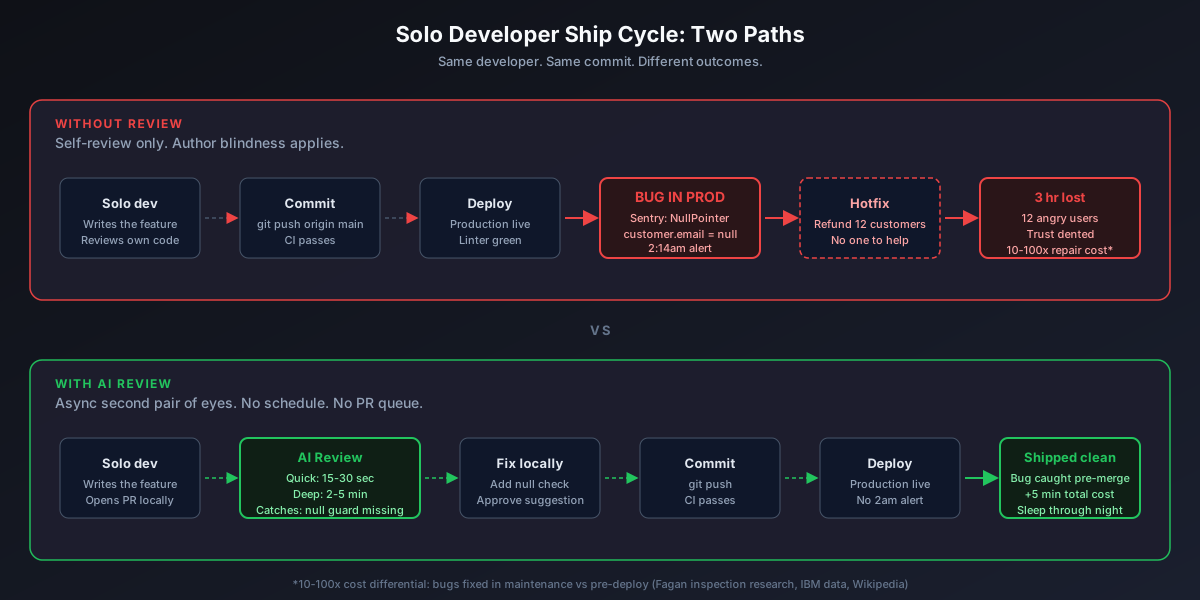
You ship a feature on Friday night, close the laptop, open Sentry on Saturday morning, and the dashboard is red. The bug is your bug. The fix is your fix. The angry customer email is your customer. No senior dev to blame, no QA to escalate to, no on-call rotation to share the pain. Solo developers carry the entire blast radius of every shipped line. The cost of one missed bug is not abstract — it is your weekend, your rent if the customer churns, your reputation in a niche where word travels fast.
This is not a rare situation. Stack Overflow's 2024 Developer Survey put 6.1% of respondents in freelancer or sole-proprietor work and 16.4% in independent contractor or freelance roles — a substantial slice of the global developer population running solo or near-solo. Layer on small-team data — 10.4% at companies with 2 to 9 employees — and a significant share of the industry is shipping production code with one or zero peer reviewers in the loop. The default story about "every PR gets two approvals" describes maybe half the industry.
The thing nobody tells you about indie development is that the technical pain is downstream of the structural pain. Big-company developers can ship a bad PR and the system absorbs it — code review caught the obvious stuff, QA caught the next layer, monitoring caught what slipped through. Solo developers have none of that. The PR you wrote is the PR that ships, and the bug you missed is the bug your customer finds. That asymmetry is why solo developers obsess over review tooling out of proportion to their team size — the downside is bigger, not smaller.
Why self-review does not work (cognitive science, not laziness)
The reason solo developers skip code review is not that they do not care. It is that reviewing your own code is cognitively close to impossible, and most people figure that out within a few attempts. You read the line, you see what you meant, you do not see what you wrote. The bug sits there because your brain reconstructs the intent from memory instead of parsing the text fresh.
Wikipedia's code review entry is unusually clear: the definition specifies that "at least one reviewer must not be the code's author." That is a hard requirement built into the methodology, because authors reviewing their own work hit a documented limit on defect detection that effort cannot lift past. The same bias that makes proofreading your own writing miss obvious typos applies to code, except the typos are off-by-one errors and missed null guards.
The mechanism is confirmation bias combined with the introspection illusion. When you read your own code, you are reading your memory of writing it, checked against the lines on screen. The two have to disagree for you to notice the bug, and they almost always agree because the same brain produced both. Pair programmers report 96% greater enjoyment and 95% higher confidence in code quality not because the second person is smarter, but because the second person reads what was written, not what was intended.
There is a second problem specific to solo developers: review fatigue without review structure. You finish a function, you scan it, you move to the next one, the previous function is now marked "done" in working memory. The brain stops checking, because checking is expensive and you have features to ship. Self-review fails not because you skip it, but because you do it while still in the wrong mental mode.
The four solo review methods, ranked by what actually works
There are four methods solo developers actually use to get review-equivalent coverage on their code, and they are not equally effective. I will walk through them in the order most solo developers discover them, ending with the one that has changed the math in 2026.
Method 1: Time-delay self-review (the cheap baseline)
You write the code today, you read it tomorrow morning with coffee. The delay flushes the working memory of "what you meant" and forces your brain to read the text as text. Every senior engineer has the experience of opening yesterday's commit and immediately seeing the bug that was invisible at 11pm. Time-delay captures the part of self-review that fails because of recency.
The catch is that time-delay only fixes the recency problem. You still wrote the code, you still know the intent, and your brain still reconstructs that intent when it reads the lines back. The bugs you find are the syntax-level ones — the off-by-ones, the missing return. The bugs that survive are the ones where what you wrote does not match what you intended.
Cost: free. Friction: high (forces a 12 to 24 hour delay, which kills the ship-fast loop indie developers depend on). Effectiveness: catches roughly the easy half of bugs. Status: minimum baseline, not a complete solution.
Method 2: Written checklist (Fagan-style inspection at solo scale)
You write a checklist of items to verify on every PR and you run through it before merge — null guards, error handling, secret leaks, test coverage, edge cases. The Fagan inspection methodology developed at IBM in the mid-1970s formalized this approach for teams, and the same logic applies at solo scale.
Our 12-item code review checklist for AI-generated code works as a starting point. The 12 items cover requirement alignment, hallucinated packages, cross-file side effects, hardcoded secrets, error handling, logic correctness, naming, dead code, test coverage, debug artifacts, OWASP Top 10, and architectural fit. The same checklist works whether you wrote the code yourself or pasted it from an AI tool.
Fagan inspection has documented defect detection rates of 80 to 90 percent in IBM data — but that is with multiple inspectors and a formal meeting. Solo execution of the same checklist lands closer to 30 to 50 percent, because the author-blindness limit applies even with structure. The checklist beats casual self-review by a wide margin. It still loses to a different person reading the same code.
Cost: free. Friction: moderate (5 to 15 minutes per PR). Effectiveness: catches mechanical bugs reliably; semantic and architectural bugs slip through. Status: pair with another method, never use alone.
Method 3: Paid peer review services
There are services that match you with a senior engineer who reviews your PRs for a per-PR or per-month fee. Pricing floor is roughly $15 to $40 per PR for surface review and $50 to $150 for deep architectural review. The math works for high-stakes PRs — payment integration, auth changes, schema migrations — and breaks down for routine work because the cost stacks fast.
The real problem with paid peer review for solo developers is not cost. It is latency. You finish a feature at 9pm, you submit it for review, the reviewer is in a different time zone, the response comes back 12 to 36 hours later. By then you have moved on, you have to context-switch back into the diff, and the review cycle takes longer than writing the code did.
There is a smaller version that works: pick one trusted senior engineer in your network and informally trade reviews. This is the version most successful indie hackers actually run, because it sidesteps the payment friction and just relies on professional reciprocity.
Cost: $15 to $150 per PR or trade-based. Friction: very high (latency). Effectiveness: highest of any human method when the reviewer is senior. Status: reserve for high-stakes changes, never use as the daily loop.
Method 4: AI code review (the method that changes the math)
AI code review reads the diff with full context and returns findings in seconds to minutes. It does not have the author-blindness problem because it did not write the code. It does not have the latency problem because it does not have a schedule. It does not have the cost-per-PR problem because it runs on a flat monthly subscription. For solo developers, the combination of zero waiting time and a fixed cost ceiling collapses the trade-off that the other three methods could not solve.
The catch is that AI review is not a replacement for human review on complex architectural decisions. It is a substitute for the part of review that catches mechanical bugs, security patterns, missing error handling, and obvious logic errors — the 70 to 90 percent of issues a competent human reviewer would catch in the first 60 minutes of looking. Solo developers usually do not have access to that human anyway, so the comparison is "AI catches most of what a peer would" versus "nobody catches anything."
Cost: $10 to $20 per month all-in (subscription plus API). Friction: very low (runs inside VS Code). Effectiveness: catches mechanical, security, and obvious logic bugs reliably; misses architectural decisions. Status: default daily loop for every solo developer shipping production code.
Why AI review fits a solo developer's ship cycle exactly
The other three methods have a coordination problem baked in. Time-delay forces a 12 to 24 hour pause. Checklist execution forces a deliberate scan that you have to make yourself do. Paid peer review forces availability matching. Solo developers operate on a ship cycle that punishes pauses — the whole appeal of being solo is that you can decide and ship in the same afternoon. Anything that forces you to wait is a tax on the work model itself.
AI review does not coordinate with anyone. You finish writing, you push the diff to a branch, the review runs, you read the findings while still in the context of the change. The whole loop fits inside the same VS Code window. Quick Review returns in 15 to 30 seconds. Deep Review takes 2 to 5 minutes — roughly the time it takes to brew coffee. Neither breaks the ship cycle.
The second thing that matters for solo developers is the BYOK pricing model. You pay $9.99 per month for the Developer plan, plus approximately $2 to $5 per month in direct API costs to Anthropic, Google, or OpenAI — you pick the provider and bring your own key. Total: $12 to $15 per month, less than one paid peer review session. Your code goes directly from VS Code to the AI provider you chose. There is no middle server, no aggregation, no third party sitting on your business logic.
The third piece is platform support. Git AutoReview works on GitHub Cloud and Enterprise, GitLab Cloud and Self-Managed, and Bitbucket Cloud, Server, and Data Center. Solo developers land on all three for different reasons — GitHub for open-source signaling, GitLab Self-Managed for compliance, Bitbucket for day jobs that bled into side projects. The same extension works across all three, so the tool follows the developer instead of the other way around.
Git AutoReview runs Quick Review (15-30 sec) or Deep Review (2-5 min) on every PR before you merge. Free plan: 10 reviews/day, 1 repo, no credit card. BYOK: Claude, Gemini, or GPT (your key, ~$2-5/mo).
Install Free Extension View Pricing
Setting up Git AutoReview as a solo developer (GitHub, GitLab, Bitbucket)
The setup is intentionally short — solo developers do not have time for multi-step DevOps onboarding.
Step 1: Install the VS Code extension. Open VS Code, search the marketplace for "Git AutoReview," install. The extension shows up as a sidebar panel inside your editor. No separate UI, no browser tab.
Step 2: Connect your Git provider. Click your platform — GitHub, GitLab, or Bitbucket — and authenticate. For GitHub Enterprise or GitLab Self-Managed, paste your instance URL plus a personal access token. For Bitbucket Server and Data Center, the same flow. The token stays on your machine.
Step 3: Add your AI API key. This is the BYOK step. Paste your Anthropic, Google, or OpenAI key into the extension settings once. Every review runs against your chosen provider at their direct rate.
Step 4: Run your first review. Open a PR in your repo, click "Quick Review," wait 15 to 30 seconds. Findings appear inline with the option to approve, edit, or reject each one. The extension posts nothing to the actual PR until you approve.
No CI pipeline to wire up, no webhook to register, no admin permissions to negotiate. Solo developers can be running their first review inside 5 minutes of installing.
The solo developer review workflow
The daily loop is short. Finish writing, commit, push to a branch, open the PR in the Git AutoReview sidebar. For most PRs, click Quick Review and wait 15 to 30 seconds. Findings come back as a list — usually 3 to 8 items for a typical feature PR, ranging from "missing null check on line 47" to "consider extracting this 40-line block into a helper." Read, approve the ones that matter, reject the rest, ship.
For high-stakes PRs — auth, payments, schema, critical paths — click Deep Review instead. The 2 to 5 minute wait is the price of full codebase context. Deep Review reads beyond the diff, follows imports, traces dependencies, and surfaces issues that only show up when you look at the whole flow. The cost is a coffee break.
What makes this work as a daily habit is that friction is lower than the alternative. The alternative is "no review at all," and most solo developers know that is what they are actually doing. After a week the workflow becomes invisible — you stop thinking about whether to run review and just run it.
The cost section: honest math for solo developers
Solo developers pay personally for everything. There is no engineering budget, no SaaS approval flow, no expense report. Every dollar comes out of revenue you have to earn one customer at a time. So the cost question for AI review is not "is it cheap" — it is "is it worth the line item against everything else fighting for the same budget."
Git AutoReview Developer plan is $9.99 per month. AI API costs run approximately $2 to $5 per month for a solo developer's typical volume. Total: $12 to $15 per month. The Team plan at $14.99 unlocks unlimited reviews and more repositories, taking the total to $17 to $20 if you genuinely need it.
The competitive comparison runs against CodeRabbit at $24 per user per month and GitHub Copilot at $19 per user per month plus the GitHub Actions minutes billing starting June 1, 2026. Git AutoReview saves you roughly $9 to $11 per month versus CodeRabbit and gives you privacy that bundled-AI tools cannot offer. Cost is not the dominant axis for solo developers — privacy and workflow fit usually decide.
The cost point that actually matters is the one solo developers do not think about until it happens. Fagan's research, verified at Wikipedia from IBM data, found that fixing a defect in maintenance costs 10 to 100 times more than fixing it during pre-deployment inspection. For solo developers, "maintenance cost" is not an abstraction — it is the Saturday you spend hotfixing instead of building, the dozen customer refunds you process by hand, the trust dent in a niche where word travels fast. One prevented production bug per year covers the entire annual cost of the tool. Most solo developers prevent that many in the first month. For the full Copilot cost picture, see our GitHub Copilot Code Review cost breakdown for 2026.
The bugs solo developers actually miss
The bugs that get past self-review fall into specific categories. Naming them is half the fix, because once you know the failure mode you can scan for it deliberately.
Logic errors where the code matches the intent in your head but not the intent in the ticket. You write the function the way you imagined the feature, you test it against the cases you imagined, and the bug is in the case you did not imagine. AI review catches a meaningful share of these because it reads the code without your imagined version overlaid on top.
Edge cases involving null, empty, undefined, or zero. The happy-path test passes, obvious failures are guarded, and the bug is in the case you forgot — empty array, zero-length string, null timezone, undefined locale. AI review is specifically good at this because the patterns are well-documented in training data.
Security issues you created yourself by treating user input as trusted. Solo developers know about SQL injection and XSS in the abstract and miss them in the concrete, because the input feels safe — "your own form," "your own API," "your own webhook." AI review reads the data flow without that trust assumption. Veracode's 2025 GenAI Code Security Report measured 45% of AI-generated code introducing at least one OWASP Top 10 vulnerability.
Cross-file side effects from renames and refactors. You rename a function, you fix the four call sites you can see, the build passes, and the fifth call site is in a file you have not touched in eight months. Deep Review specifically explores cross-file dependencies and is built for this category.
Debug artifacts left in production code. The console.log, the commented-out TODO, the temporary endpoint you exposed during testing, the hardcoded test user ID. Solo developers leave these in at a higher rate because nobody is going to read the diff before merge except you. AI review catches debug artifacts almost perfectly because the patterns are unambiguous.
These five categories are exactly the bugs a junior peer reviewer would catch in 10 minutes of looking. Solo developers do not have the junior peer reviewer. AI review is, for these specific categories, a structural substitute.
Git AutoReview runs on GitHub, GitLab (Cloud + Self-Managed), and Bitbucket (Cloud + Server + Data Center). Quick Review (15-30 sec) or Deep Review (2-5 min). Free plan: 10 reviews/day. BYOK: ~$2-5/mo direct API costs.
Install Free Extension See How It Works
5 rules for effective solo code review
If you take only one piece of the article into practice, take this list. These five rules separate solo developers who ship clean from solo developers who hotfix on Saturdays.
Rule 1: Never review your own code in the same session you wrote it. Either delay the review (next morning minimum) or hand the review to a tool that did not write the code. Same-session self-review is the worst version of every option — it has all of the author-blindness with none of the structural compensation. If you must self-review on the same day, at least walk away for an hour and come back to it fresh.
Rule 2: Read the diff against a written checklist, not from memory. The checklist forces you to scan for specific categories instead of relaxing into "looks fine." Use the 12-item checklist for AI-generated code as a template and adapt the items to your codebase. Even a 6-item checklist beats no checklist by a wide margin.
Rule 3: Run AI review on every PR, not just the high-stakes ones. The bugs you miss are not in the PRs you flag as high-stakes. They are in the PRs you marked as "trivial" and shipped without thinking. Quick Review takes 15 to 30 seconds — the cost of running it on every PR is smaller than the cost of one missed bug in a "trivial" PR that turned out not to be trivial.
Rule 4: Save Deep Review for changes that touch shared state. Auth, payments, database schema, environment variables, public APIs, anything that other parts of the system depend on. Deep Review is the tool that earns its 2-to-5-minute cost on these PRs by reading the cross-file impact you cannot see from the diff alone. Use Quick Review as the default and escalate to Deep when the blast radius is large.
Rule 5: Trust the tool to be wrong sometimes, and ship anyway. AI review will flag things that are not bugs. It will miss things that are. The point is not to obey the tool — the point is to give yourself a second perspective on every PR. When the tool flags something you disagree with, reject it and ship. When it misses something obvious, fix it manually and ship. The job is shipping correct code, not satisfying a review tool.
Frequently asked questions
Is AI code review good enough for a solo developer?
For solo developers, AI review fills the one gap that matters most — a second pair of eyes that does not belong to the author. The cognitive bias that makes self-review weak (you cannot un-know what you intended the code to do) does not apply to a tool reading the diff with no prior context. AI catches a high share of mechanical bugs, security patterns, and obvious logic errors that human authors routinely walk past. It does not replace deep architectural judgment — that part stays with you.
How does AI code review differ from a linter?
A linter checks syntax against rules you configured ahead of time. AI review reads the diff in context, understands what the code is trying to do, and flags semantic issues the linter has no way to see — wrong null handling on a value that could legitimately be null, missing error paths, security patterns specific to the framework, logic that compiles fine but produces the wrong result. The two are complementary, not competing. Linters catch what they were taught. AI reads what you wrote.
What if I already use GitHub Copilot for code generation?
Copilot writes code. AI code review reads code. Different jobs, different failure modes. Copilot accelerates the part where you produce diffs, which means more code lands faster, which means the review side of your pipeline matters more than ever. Solo developers using Copilot without a review step are essentially compounding author blindness with AI-pattern blindness. The review tool catches what the generator missed.
Can I use Git AutoReview on private repos as a solo developer?
Yes. The free plan covers 10 reviews per day on 1 repository, which is enough for most solo developers shipping a few times a week. The $9.99/mo Developer plan goes to 100 reviews per day across 10 repositories. Both work on private repos. You bring your own API key (Claude, Gemini, or GPT) and the code never touches our servers — it goes directly from VS Code to the AI provider you chose.
How long does AI code review take for a typical PR?
Quick Review returns in 15 to 30 seconds — enough time to grab water. Deep Review takes 2 to 5 minutes for a typical PR and 5 to 8 minutes for very large ones, because it reads beyond the diff and explores the surrounding codebase. For a solo developer shipping 2 to 5 PRs per day, the total daily overhead is roughly the same as reading one extra coffee shop sign.
What does code review actually cost for a solo developer?
Git AutoReview Developer plan is $9.99 per month, plus approximately $2 to $5 per month in AI API costs paid directly to Anthropic, Google, or OpenAI — you pick the provider and bring your own key. Total: $12 to $15 per month. The point of comparison is not other review tools. It is the cost of one production bug that wakes you up at 2am — including refund time, customer trust, and the hour you lose searching the diff that should have caught it.
Will AI review work with GitLab Self-Managed or Bitbucket Server?
Yes. Git AutoReview supports GitHub (Cloud and Enterprise), GitLab (Cloud and Self-Managed), and Bitbucket (Cloud, Server, and Data Center). Solo developers are unusually likely to land on self-hosted Git providers — for compliance, cost, or because the day job pushed them onto one. The extension treats all three the same: pull the diff into VS Code, run the review, push the suggestions back.
What should I do if AI review flags something I disagree with?
Reject the suggestion and ship. The point of AI review for a solo developer is not to add a second authority — it is to add a second perspective. You make the final call on every flag. Git AutoReview's design assumes the human approves suggestions before they post anywhere, which means false positives cost a click, not a real fight in the PR thread. Over time you tune the prompts and the tool gets quieter on the patterns you keep rejecting.
The bottom line for solo developers
You will ship bugs. Every developer does. The question is whether you ship them at 2pm when you can fix them quietly, or at 2am when they wake you up. Solo developers who run AI review on every PR ship the first kind. Solo developers who skip review ship the second kind, because the same bias that lets the bug into the PR also lets it past the self-review.
The 2026 economics make this an easy call. Flat $12 to $15 per month buys a second pair of eyes on every change, runs inside the VS Code window you already live in, works across GitHub, GitLab, and Bitbucket, and pays for itself the first time it catches a production bug — which for most solo developers is inside the first week. The hardest part of being solo is not the code. It is operating without the safety nets big-company developers do not notice until they leave. AI review is the cheapest piece of that safety net to install. For where AI review fits in 2026 cycle times, see our PR review time benchmark 2026.
Git AutoReview free plan: 10 reviews per day, 1 repository, no credit card. Developer plan: $9.99/mo for 100 reviews/day across 10 repos. Team plan: $14.99/mo unlimited. BYOK: Claude, Gemini, or GPT (your key, ~$2-5/mo direct API costs).*
Install Free Extension View Pricing
* Git AutoReview subscription price only. The ~$2 to $5 per month in AI compute costs are paid directly to the AI provider (Anthropic, Google, or OpenAI bills you at their direct rate). CodeRabbit ($24/user/mo) and Qodo (a $30/mo base plus metered credits) bundle AI compute into their per-user price. Honest total monthly cost for a solo developer on Git AutoReview Developer plan: $12 to $15.
Related Resources
- Code Review Checklist for AI-Generated Code — the 12-item checklist that works as a solo dev's checklist template
- GitHub Copilot Code Review Cost 2026 — what the June 1 change means for solo developers running Copilot
- PR Review Time Benchmark 2026 — industry data on review cycles and where solo devs fit
- AI PR Review Guide — full product overview for solo developers and small teams
- Diff Bots vs Agentic Review — why Deep Review reads more than the diff
Sources
- Stack Overflow Developer Survey 2024 — 6.1% solo proprietors, 16.4% independent contractors, 10.4% at 2-9 employee firms
- Code Review (Wikipedia) — definition specifies "at least one reviewer must not be the code's author"
- Fagan Inspection (Wikipedia) — IBM data, 80 to 90 percent defect detection, 10 to 100x cost differential
- SmartBear Peer Code Review Best Practices — 200-400 LOC max, 60-90 min session, 70-90% defect detection
- Rubber Duck Debugging (Wikipedia) — origin in The Pragmatic Programmer, mechanism for solo developers
- Pair Programming (Wikipedia) — meta-analysis findings on defect reduction and effort increase
- Software Bug (Wikipedia) — NASA Goddard 4.5 to 1 per 1000 SLOC, 20% bug-fix effort median (GitHub 2020)
- OWASP Top 10:2021 — current authoritative list of web application security risks
Tired of slow code reviews? AI catches issues in seconds. You decide what gets published.
Frequently Asked Questions
Is AI code review good enough for a solo developer?
How does AI code review differ from a linter?
What if I already use GitHub Copilot for code generation?
Can I use Git AutoReview on private repos as a solo developer?
How long does AI code review take for a typical PR?
What does code review actually cost for a solo developer?
Will AI review work with GitLab Self-Managed or Bitbucket Server?
What should I do if AI review flags something I disagree with?
Try it on your next PR
AI reviews your code for bugs, security issues, and logic errors. You approve what gets published.
Free: 10 AI reviews/day, 1 repo. No credit card.
Related Articles
Jira to Pull Request: Closing the Loop Between Tickets and Code Review 2026
Most teams mark Jira tickets Done before the PR gets a real review. Here's how to wire Jira to GitHub, GitLab, and Bitbucket so ticket context drives code review — and nothing ships unverified.
Monorepo AI Code Review 2026: How AI Handles Large Diffs and Cross-Package Changes
AI code review breaks on 2,000-line monorepo PRs. Here's how to scope it to affected packages, avoid context window truncation, and keep review quality high across Nx, Turborepo, and pnpm workspaces.
PR Review Time Benchmark 2026: How Long Code Reviews Actually Take
Industry benchmark data on PR review time: median time-to-first-review, how PR size changes the math, and what AI pre-review does to the cycle. 2026 data.
Get the AI Code Review Checklist
25 PR bugs AI catches that humans miss — with real code examples. Free PDF, sent instantly.
One-click unsubscribe. We never share your email.